Cream or White Paper on KDP: Which Suits a Coloring Book?
White and cream paper cost the same to print on KDP; what changes is the spine and the page limit, and we checked what 203 kids' coloring books on Amazon say about paper.
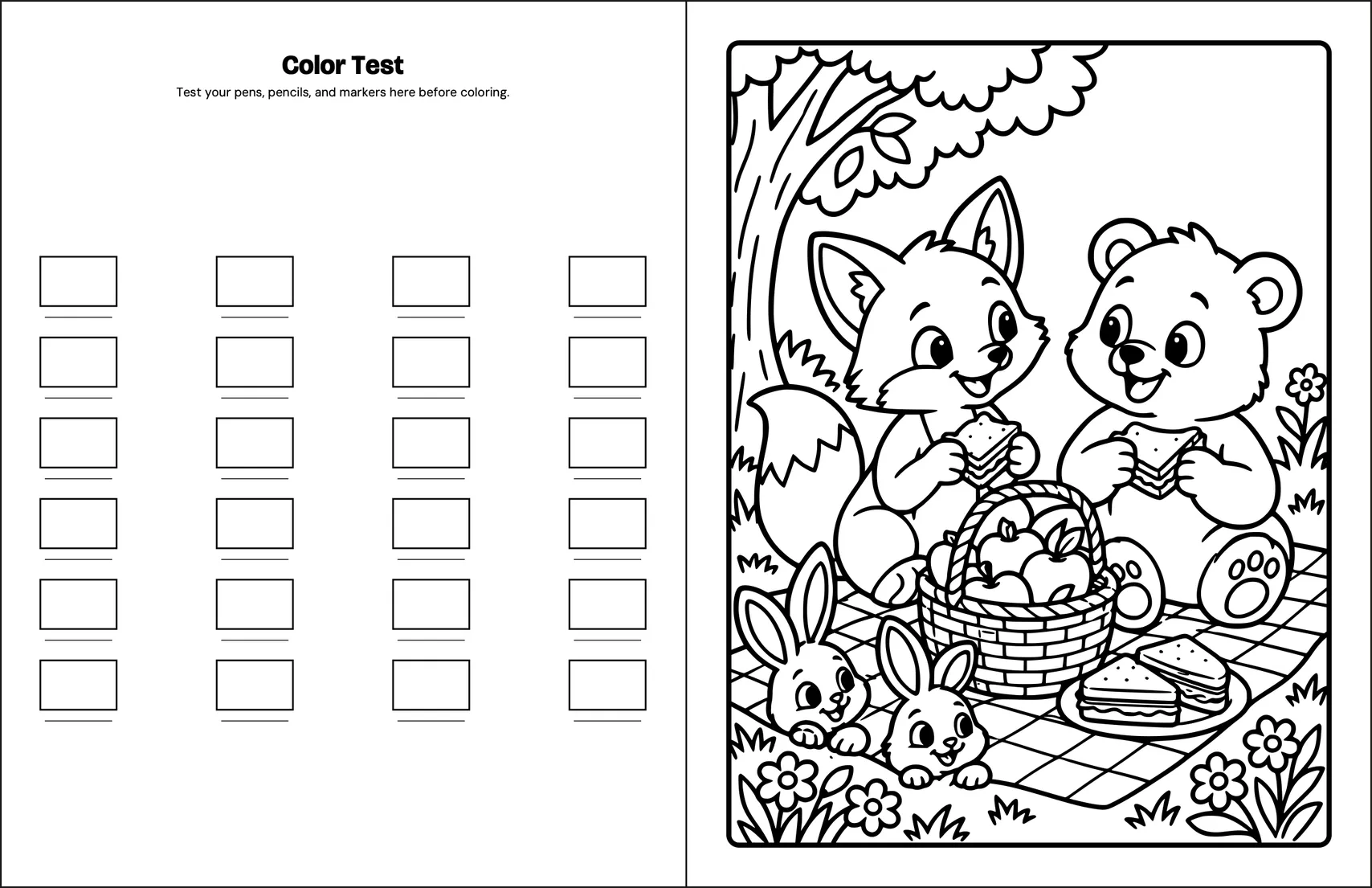
For a black-and-white kids’ coloring book, choose white paper. The KDP white vs cream paper decision does not change the printing cost, but it does change the spine width and maximum page count. To separate useful differences from publishing folklore, we compared KDP’s own specifications with listing text from 203 kids’ coloring books on Amazon.com on November 12, 2026.
KDP White vs Cream Paper: What KDP Actually Specifies
KDP offers black-ink paperbacks on white, cream, or groundwood paper, and says nothing that ranks one above the others for a genre.
Its Print Options page lists white and cream at the same range: 50–61 lb (74–90 GSM). Paper weight varies by printing location. Groundwood is lighter at 45 lb (60 GSM), while both standard and premium color interiors use white paper in their respective weight ranges.
In the KDP pages checked on November 12, 2026, there was no recommendation to use cream for fiction or white for nonfiction. KDP does say that groundwood can suit novels and text-heavy books because of its opacity and texture. That is a statement about groundwood, not a rule assigning every genre a paper color.
Cover finish is also a separate decision. KDP describes glossy covers as typical for textbooks, children’s books, and nonfiction, and matte covers as typical for novels and other fiction. Those covers are printed on 80 lb (220 GSM) white stock regardless of the interior paper. A glossy children’s-book cover does not mean the pages inside must be white.
What is the difference between white and cream paper?
Both are 50–61 lb (74–90 GSM) stock in KDP’s Print Options; cream has a warmer tone and is about 11% thicker per page in KDP’s spine formula.
KDP’s cover guide calculates a white-paper spine at 0.002252 inches per page and a cream-paper spine at 0.0025 inches per page. The ratio makes cream roughly 11% thicker in this calculation. That affects the cover template, even when the page count and trim size stay fixed. It does not establish that one stock feels thicker in every printed copy, since KDP says paper weight varies by printing location.
Does Amazon KDP print on white or cream paper?
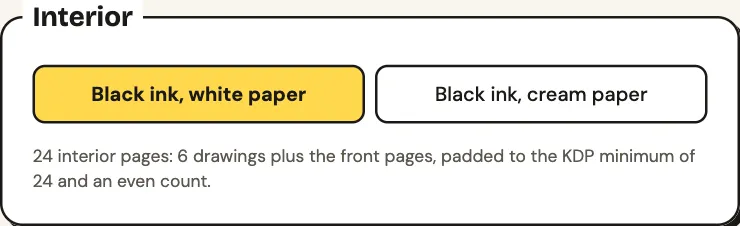
KDP prints black-ink books on white, cream, or groundwood paper; books with color ink use white paper.
KDP’s stated reason is that white paper gives images and graphics higher contrast. For a black-and-white interior with gray backgrounds, its Paperback Submission Guidelines recommend a minimum grayscale fill of 10% on either white or cream paper.
What Changes: Spine Width, Page Limits, and Printing Cost
Printing cost is the same for white and cream; spine width and maximum page count are not.
The page caps vary by trim group. Every black-ink option has a 24-page minimum, and a typical 24–110-page coloring book remains far below every maximum.
| KDP trim sizes | White maximum | Cream maximum | Groundwood maximum |
|---|---|---|---|
| 5 × 8 through 8 × 10, including 6 × 9 | 828 | 776 | 812 |
| 8.25 × 6 and 8.25 × 8.25 | 800 | 750 | 784 |
| 8.27 × 11.69 (A4) | 780 | 730 | 764 |
| 8.5 × 8.5 and 8.5 × 11 | 590 | 550 | 578 |
See every KDP coloring-book trim size, bleed setting, and pixel size before building the interior. Paper choice does not decide the trim, but it can alter the longest book that trim accepts.
For an 8.5 × 11-inch book, the full cover width is the 17 inches occupied by the front and back, plus 0.25 inches of bleed, plus the spine. KDP’s formulas produce these dimensions:
| Pages | White spine | Cream spine | White cover width | Cream cover width |
|---|---|---|---|---|
| 24 | 0.0540 in | 0.0600 in | 17.3040 in | 17.3100 in |
| 48 | 0.1081 in | 0.1200 in | 17.3581 in | 17.3700 in |
| 100 | 0.2252 in | 0.2500 in | 17.4752 in | 17.5000 in |
| 150 | 0.3378 in | 0.3750 in | 17.5878 in | 17.6250 in |
At 100 pages, cream adds 0.0248 inches, or 0.63 mm, to the spine. Small, yes. Optional, no. Your cover file still has to fit the selected paper. Read the coloring-book cover rules before placing artwork, and use the KDP cover calculator to check the exact spine for white, cream, or groundwood.
CrayonForge’s Export step recomputes the spine when you switch between white and cream, so the cover follows the chosen template rather than keeping the previous dimensions.
Does cream paper cost more on KDP?
No. KDP publishes one printing-cost table for black-ink paperbacks with “cream or white paper.”
On Amazon.com, a large-trim black-ink book from 24 through 110 pages costs $2.84 to print. Above that band, the formula is $1.00 plus $0.017 per page. An 8.5 × 11-inch book is a large trim, so 100 pages costs $2.84 on white or cream, and 120 pages costs $3.04 on either. These are Amazon.com figures; other marketplaces differ. Check printing cost and royalty by marketplace rather than carrying one market’s result across every store.
KDP says trim size, page count, ink type, and paper type can affect cost, but its cream-and-white table groups those two stocks at the same price. Bleed and cover finish do not change printing cost, according to its Paperback Printing Cost page.
Which Paper Do Kids’ Coloring Books on Amazon Use?
Almost no listing says: among 203 kids’ coloring paperbacks, none mentioned cream paper and 19 mentioned white paper.
We collected Amazon.com results on November 12, 2026, across seven kids’ coloring-book searches and two result pages per search. Sponsored results were excluded. From 313 unique ASINs, the sample kept 203 listings with both an ISBN-13 and a print length. Their median length was 102 pages.
| Phrase or feature found in listing text | Books | Share of 203 |
|---|---|---|
| Single-sided or one-sided pages | 88 | 43% |
| Crayons or colored pencils | 64 | 32% |
| Markers | 58 | 29% |
| White, bright white, or white pages | 19 | 9.4% |
| Paper weight or thick, heavy, or sturdy paper | 11 | 5.4% |
| Thin paper | 1 | 0.5% |
| Cream, ivory, or off-white paper | 0 | 0% |
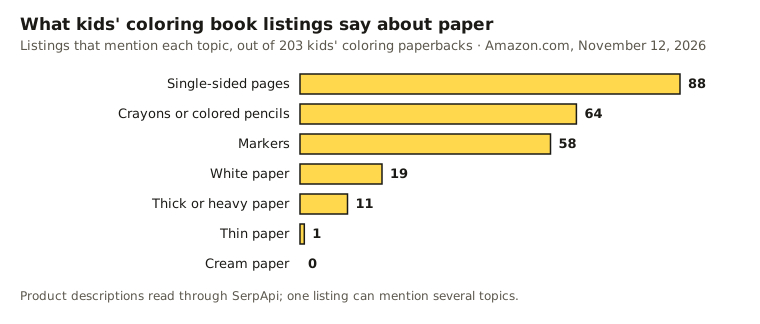
Download the listing-level CSV to inspect the titles, publishers, page counts, dimensions, and per-book flags. The counts are regex matches in titles, descriptions, bullet points, and item highlights on one date in one market. They are not a survey of the paper inside printed copies.
Amazon does not expose a paper-color field on the product page, and it does not publish which stock each book uses. Silence about cream therefore cannot prove that a book was printed on white. It shows how sellers describe their products: single-sided pages and bright-white claims appear, while paper color usually does not. For a separate view of the category, see what bestselling coloring books have in common.
Is cream or white paper better?
For a coloring book, white is the stronger default because KDP says white shows higher contrast for images and graphics, and coloring pages are line art meant to be colored.
One reply in the KDP Community similarly suggests white when images matter and cream for primarily textual books. That is community advice, not a KDP specification. We found no KDP or Amazon comparison showing that cream harms coloring, and we did not physically test the two papers. The recommendation rests on KDP’s contrast guidance and the purpose of the interior, not an invented paper trial.
Single-Sided Pages and Markers
Blank backs address marker bleed-through more directly than paper color: 88 of 203 listings promote single-sided pages.
Listings often connect the layout to a promise such as “Single-sided pages to prevent bleed-through.” Yet product copy is not a materials test. KDP publishes no bleed-through or opacity specification comparing its white and cream stocks.
Amazon supplied AI-written “Customers say” summaries for 189 of the 203 books. Across summary text, insight blurbs, and example snippets, 35 books mentioned bleed or show-through, 41 mentioned thick, heavy, or sturdy pages, 22 mentioned thin paper or pages, and 41 mentioned markers. Positive and negative mentions are counted together, so these are discussion counts, not complaint rates.
Nine books had an insight headed “Bleed resistance” or “Bleed-through”: five were mixed, two negative, and two positive. Five of those nine listings also advertised single-sided pages. Of all 88 listings promoting single-sided pages, 19 review-summary texts still mentioned bleed or show-through; 16 of the other 115 did too. A mention can be positive, such as saying ink does not bleed, so this is not a quality comparison.
The useful conclusion is narrower. Single-sided printing is a layout choice, while buyers may still discuss bleed. Blank backs also double the interior page count. Follow the page-count math in how to make a coloring book for KDP rather than counting only the illustrated sides.

CrayonForge’s “Single-sided, blank backs” option is on by default in the Brief step, and its page count includes those backs, so 40 drawings are counted as at least 80 interior pages from the start.
Where Groundwood Paper Fits
Groundwood is KDP’s cheaper black-ink paper, but KDP says books with heavy ink coverage are not eligible or recommended for it.
On Amazon.com, large-trim groundwood books from 24 through 112 pages cost $2.75 to print, compared with $2.84 for white or cream, a saving of about $0.09. At 120 pages, the large-trim formula gives about $2.94 on groundwood versus $3.04 on white or cream, roughly $0.10 less. Groundwood’s $0.0162 per-page rate is about 4.7% below $0.017. These comparisons come from KDP’s Paperback Printing Cost table and apply only to Amazon.com.
The lower price comes with a relevant restriction. KDP says heavy ink coverage is not eligible or recommended because ink can show through. If printing problems occur, KDP reserves the right to change the stock to cream or white. Groundwood remains eligible for black-and-white paperbacks in every trim size, but that warning makes it a poor default for coloring pages with potentially dense line work or gray areas.
KDP describes groundwood as suited to paperback novels and text-heavy books. Its spine multiplier, 0.00235 inches per page, sits between white and cream. The Groundwood Paper page also says its per-page printing costs are approximately 5% lower than cream and white.
The CrayonForge AI coloring book generator exports black-and-white interiors for white or cream paper only; groundwood is not offered. White remains the default because KDP’s own image guidance favors white for higher contrast.
Pick White, Then Set It Once
Choose the interior paper before making the cover, carry that selection into KDP exactly, and order a proof before publication.
Use this sequence:
- Plan the page count. Include every blank back created by a single-sided layout.
- Choose white or cream. For a kids’ coloring book, start with white unless you have a specific reason not to.
- Calculate the spine. Paper changes the multiplier, so build the cover only after the selection is final.
- Match the KDP setup. Select the same black-ink paper option used for the cover calculation.
- Inspect a proof copy. KDP itself recommends ordering one to confirm that the selected ink and paper fit the book.
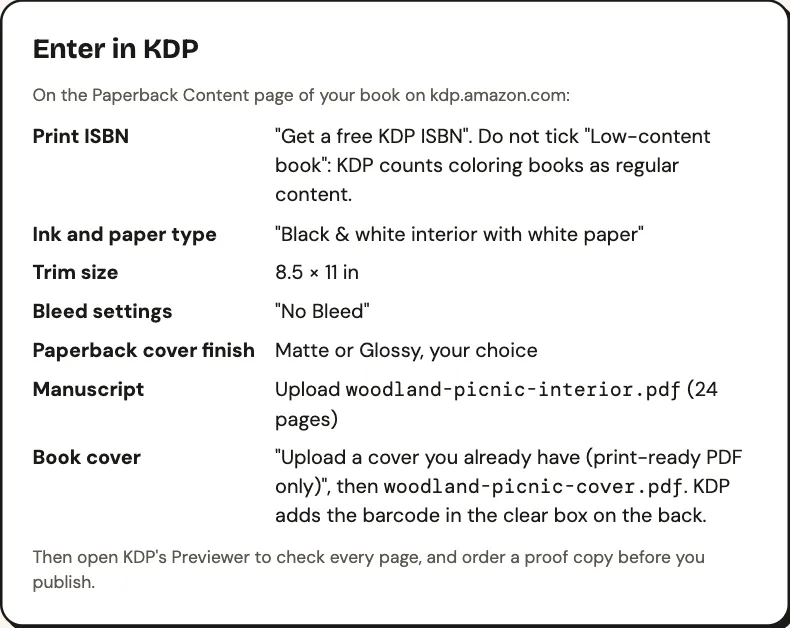
CrayonForge puts these decisions in two places: blank backs in the Brief step, then white or cream paper in Export. The “Enter in KDP” table repeats the exact setting, including “Black & white interior with white paper” when white is selected. It also shows the trim, no-bleed setting, cover finish, free KDP ISBN, and the instruction not to tick Low-content.
A 24-page, 8.5 × 11-inch Woodland Picnic file using white paper and no bleed passed KDP Print Previewer without issues on November 11, 2026. That was a digital preflight result, not a printed-paper comparison; no physical proof has been produced for it.
KDP allows a published black-ink paperback to switch between white, cream, and groundwood paper. Depending on page count, the change may require a new cover file because the spine changes. Ink type is different: KDP says black-and-white, standard color, and premium color cannot be switched after publication because of ISBN requirements.
For the practical KDP white vs cream paper choice, pick white, calculate the matching spine, and verify the result with a proof. Then start a coloring book (drawing credits are on the pricing page), or browse the CrayonForge blog for the next KDP production decision.
CRAYONFORGE
Make your kids' coloring book for KDP
Describe the theme and age, get a scene for every page, draw them, then export interior.pdf and cover.pdf checked against KDP's rules. New accounts get 5 free credits.
More guides
Nov 12, 2026
30 Kids' Coloring Book Ideas, Checked Against Real Amazon Data
Which kids' coloring book themes sit high on Amazon, which have room for an independent publisher, and which ideas to skip, from 153 books read on November 12, 2026.
READ THE GUIDE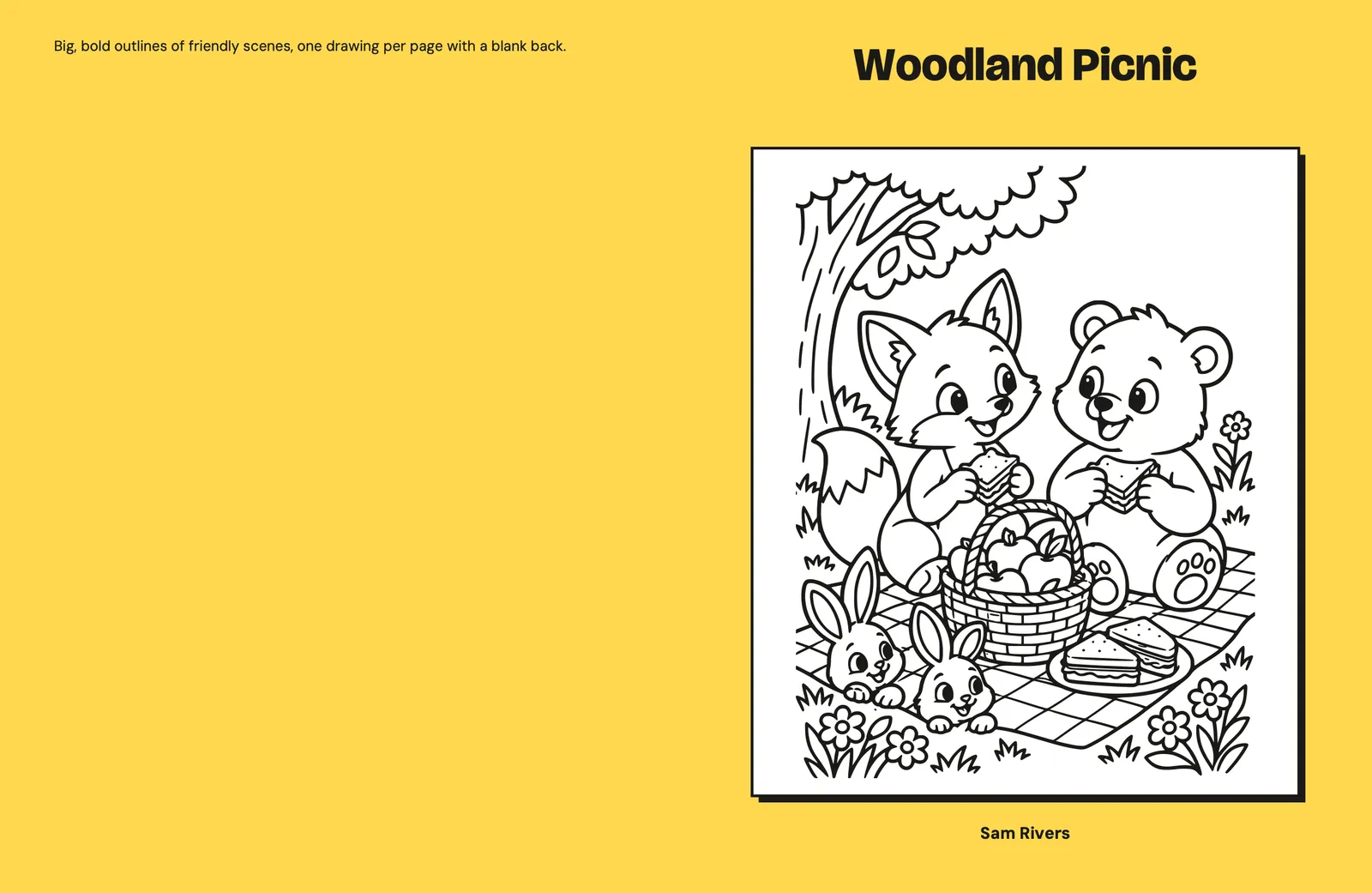
Nov 12, 2026
How to Publish a Coloring Book on Amazon KDP, Field by Field
To publish an Amazon KDP coloring book you fill in three pages (Details, Content, Rights & Pricing), and four answers differ from other books: leave Low-content unticked, take the free ISBN, skip Expanded Distribution and disclose AI-generated drawings.
READ THE GUIDE
Nov 11, 2026
Amazon Best Selling Coloring Books: What Both Top 100 Lists Show
Who publishes the kids' and adult top 100, which formats lead, how many pages and what size, from both Amazon lists on November 6, 2026.
READ THE GUIDE